
Wholeness
Is happiness the ultimate prize?

Last month I wrote about wanting to be happy. (If you haven’t read that piece, you can find it here.) Since then, I’ve been sitting with the question of happiness, turning it over in moments of contemplation, listening for what’s underneath it. I like doing this a lot, playing with my own opinions, with my own convictions, turning them over, questioning them, shaking them a little and noticing how they stand, or whether they remain standing at all.
One day, as I was catching up on old podcast episodes with the volume low in the background, I heard something that made me stop.
“I no longer ask myself if I’m happy. I ask myself if I’m whole.”
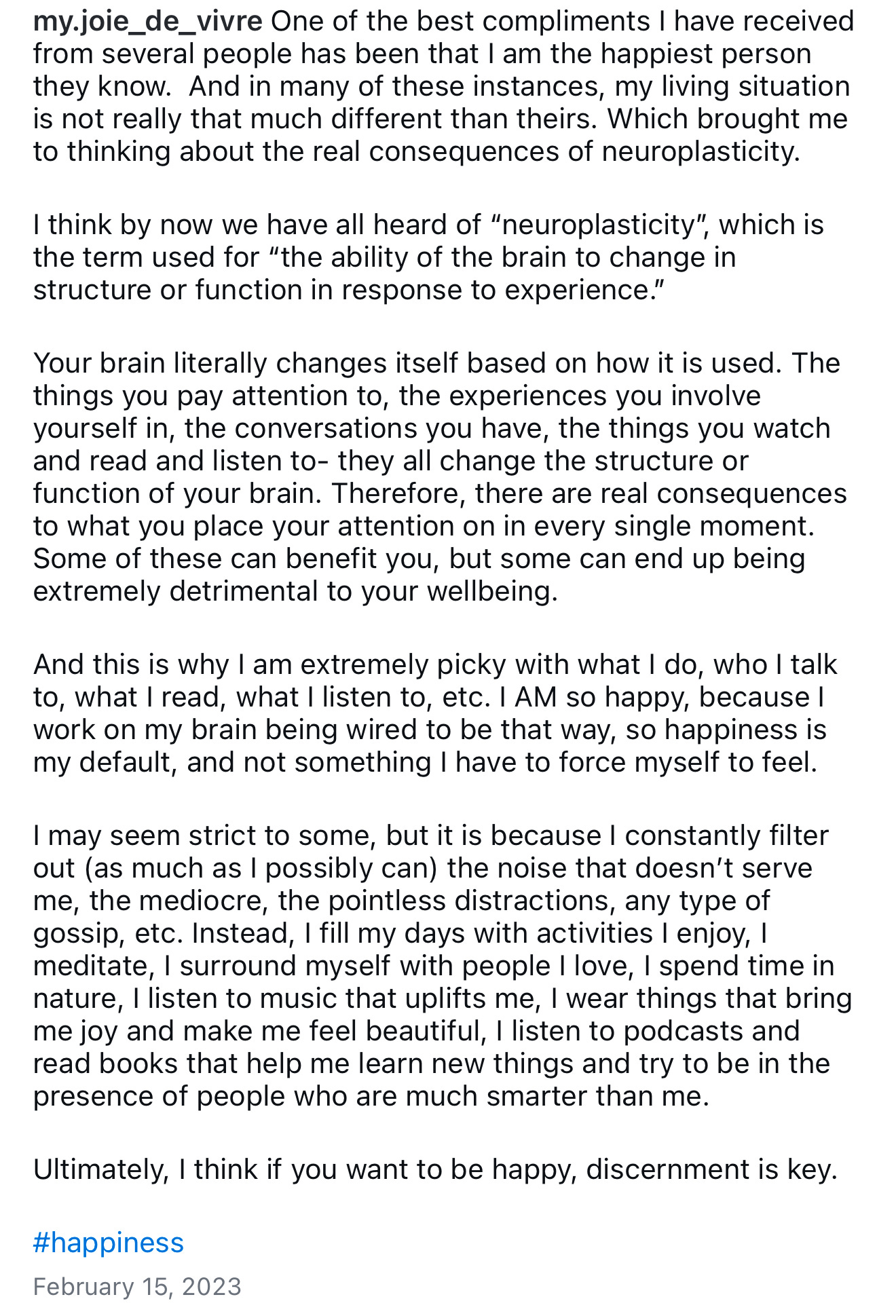
I got goosebumps. I have always prided myself when my friends would tell me that I am the happiest person they know. I’ve written about choosing to be happy in the sense that everything we consume literally changes our brain. Every thing big or small that we are exposed to changes our brain. And so, I have often asked myself, in many different situations: “Am I happy?”
It seemed like the right question. A noble one, even. Something bright and golden to aspire to. Looking back, I see now however, that every time I said I was happy, or content, or satisfied, it was really just a fragment of something deeper, just one aspect of feeling whole. Happiness, as we tend to define it, is about comfort. It’s about ease, lightness, clarity. A peak state, often laced with a little sparkle, something we’re taught to reach for, to hold up as evidence that life is good, that we are doing it right. And God knows I love those moments! I cherish them. But I’ve come to see that chasing happiness can become a kind of distortion, a distraction masquerading as purpose. Chasing happiness gives you an illusion of arrival. It’s a longing for endless spring, when life, in its truest form, is made of seasons.
Wholeness is different.
Wholeness is what you feel when you're sitting in a hospital room, holding the hand of someone you love, and nothing about that moment feels light or beautiful, and yet, there you are, entirely present, and you know, in the marrow of your being, that there is nowhere else you are meant to be. It is what I felt as I sat by my father’s deathbed, his breath slowing, his grip loosening, my own heart breaking in that private way death has of undoing you. I wasn’t okay, but I was there, and I wouldn’t have chosen to be anywhere else. That presence felt like the opposite of happiness…but it did feel like wholeness.
This might not feel good right now, but it is good that I am here. That is wholeness.
I’ve recognized it again in other rooms, too…rooms full of noise and laughter, or rooms filled only with the soft rhythm of daily life. When my daughters lean into me without any words. When my husband and I move around the kitchen without speaking, both of us knowing exactly what comes next. When a quiet moment stretches out without needing to be filled. These are not sparkling, Instagram-worthy moments. But they are full. And in that fullness, I realize now that being whole doesn’t always mean being happy.
And then there are days like today, when I walked alone by the ocean, the sky impossibly blue, the tide pulling its slow breath in and out. No one was waiting for me in that moment. Nothing was required of me. And I felt this peace wash over me. Aliveness. A belonging to the moment. I wouldn’t describe it as joy. It wasn’t pleasure, exactly. But it felt like wholeness.
I have come to understand something I hadn’t fully seen before: that happiness is a subset of wholeness, an expression that can only emerge when something deeper is already intact. You cannot feel genuinely happy without some sense of inner coherence. But you can be whole without being happy. Wholeness is more spacious. It makes room for sorrow, for silence, for not knowing. It is the full composition, capable of holding ache and beauty, contradiction and peace, all at once. Wholeness is the foundation, the place in you that remains even when joy departs. I’ve had many moments when I wasn’t happy at all, and yet I didn’t feel lacking. I felt anchored, as though I was living in alignment with something steadier than mood and more essential than ease.
A big shift happens when we stop measuring our lives by how enjoyable they are and begin to ask instead: Is this aligned with my values? Is this right? Am I living with integrity to my being, even when it hurts, even when it’s uncomfortable? Because joy, delight, clarity…they come and go. And so do doubt, grief and loneliness. The seasons turn, and no one gets to stay only in summer. But none of these seasons make you less worthy. None of them are signs that you’re failing. They are signs that you’re alive. And strangely, it is often in the hardest seasons that we become the most whole. And no, I am not proclaiming by any means that suffering is noble. But presence is. Staying awake to life as it is, without numbing, and without fleeing, requires courage…And that courage is usually what transforms us.
This isn’t about feeling good all the time. It’s letting every feeling shape you without letting any one of them define you. To be whole is to allow the full range of human experience complete you, not fracture you.
It reminds me of something Nisargadatta Maharaj once said: “In my world, nothing ever goes wrong.” Notice he doesn’t say everything goes “right.” That would imply control, preference, or ease, none of which he promises. What he’s pointing to is not a life without difficulty, but a way of seeing in which the very concept of “wrong” no longer makes sense, because the need for the moment to be anything other than what it is dissolves.
Wholeness doesn’t insist on being happy or feeling good. It allows even the hard, unchosen moments to belong. When we stop sorting our experiences into successes and failures, and instead let them stand as they are, something else often reveals itself. Sometimes only in hindsight, but wholeness was there, even then. What if nothing has ever gone wrong at all, and it was only misunderstood?
So no, I no longer see happiness as if it were the ultimate prize. I am not looking for the glittering proof of a life well lived. I am letting life live through me, in its fullness, whether it is in its ache, in its silence, or in its joy. And I am now learning to ask only: “Am I whole here?” And if the answer is yes, if I am present, if I am truthful, if I am loving where love is called for, staying where staying matters, then I don’t need happiness to affirm me. I am already home.
To be continued…
Wishing you all a beautiful day,
Mihaela
This article resonates deeply. That's what life taught me these 3 past years. For me happiness is not a state you reach by doing certain actions or achieving certain goals (what I used to believe). It's more a choice of living your life fully in all her shades. I understood that joy is possible in every moment even the hardest ones because of the presence you write so beautifully about, because of surrendering what we can't control and accepting to go through what life has to offer and teach us. It really transformed the taste of my day to day life, I don't try to escape anymore and when I stay with the hard things, thoughts, emotions, when I invite them for tea and learn to know them I realize they are part of my beautiful life too, they also make my life so unique. Thank you Mihaela !
I've always found the obsession with being happy strange. It's quite literally chasing a chemical high. It's the same mindset that seeks to medicate or mask pain and discomfort instead of understanding it for its intended purpose: a signal, and not necessarily a signal that something is wrong either. Happiness as some sort of permanent state or end goal just makes no sense, either philosophically or biochemically. The concept of being happy all the time borders on delusion.
I've had many of the same ideas and intuitions of "wholeness"; I've used the word "equanimity", but I think the idea is the same.
Great stuff!