
Mutual Delusions
Masks, continued

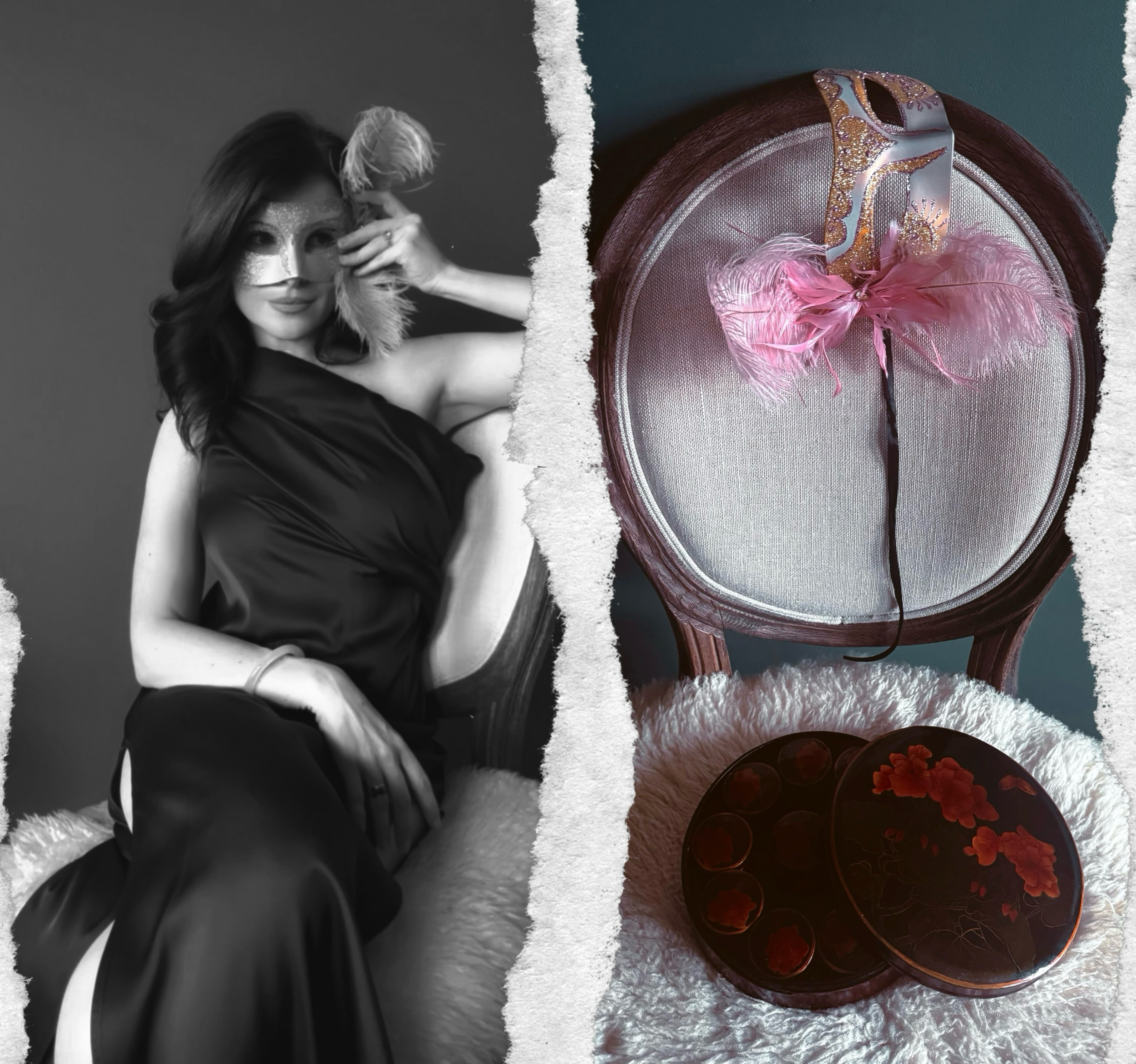
This is most likely going to be a topic I will keep returning to. I have already written about masks on several occasions, and here I am again, only from a slightly different angle.
We live in a culture that praises “being yourself.” They should accept you for who you are, they say, and if they cannot, then good riddance. What you wear does not matter. Your car does not define you. Your status, your title, your relationship status are just labels. You should speak your mind, always. “Protect your peace,” and “burn those bridges.” People should not judge a book by its cover.
True… and also incomplete.
Because there is a missing question hidden inside all that advice. When we say “be yourself,” do we even know who that is?
Do we know who we are beneath the versions of ourselves that have been rewarded throughout our entire lives? Do we truly know who we are beneath the roles we perform so well that we forgot they were roles to begin with? Do we know who we truly are beneath the persona that gets us hired, liked, forgiven, desired, or left alone? Beneath the voice we use to sound competent, the laugh we use to sound agreeable, the restraint we use to look unbothered, the opinions we keep quiet so we do not lose our place in groups we are part of? Is it even really possible to know who we truly are without all these things?
This is not a moral accusation. It is an observation of how we become different versions of ourselves at different times and in different circumstances of our lives.
As soon as we walk into a room, we are judged before we even speak for the simple fact that human beings have to make fast, practical interpretations in order to navigate one another. Safe or unsafe. Warm or punishing. Confident or brittle. Interested or contemptuous. This is just the baseline of social life.
Your clothes, your posture, your movement, your voice, your eye contact, even the condition of what you wear, may not tell the whole truth about who you are, but they are never nothing. Wrinkled or pressed. Scuffed or polished. A steady gaze, or eyes that keep looking away. Shoulders braced like you’re preparing for impact, or a body that is relaxed because it feels safe. A voice that is warm, clipped, overly careful, or daring. Even your vocabulary is a signal.
Even when you dress plainly so nobody notices, you are still communicating something. Camouflage is still a signal. A quiet wardrobe can be a boundary. A careful tone can be armor. A blunt tone can be armor too. Minimalism can be a philosophy, it can be hiding, and it can be both. Even “I didn’t think about it” is still a message. Even “I don’t care what anyone thinks” is still a strategy.
When we say “be yourself,” we usually mean “stop performing.” But performance, in most cases, began as adaptation. Most of us learned, early, which version of us got rewarded, tolerated, admired, forgiven, or left alone. We learned what cost us love. We learned what drew punishment. We learned what made adults gentler and what made them harden. By the time we are grown, our so-called “natural” way of presenting ourselves often has years of social consequence behind it. The self you think of as private has actually been trained in public.
Jung called it the persona, the social face, the mask that helps us function and belong, and it is not fake. The persona is necessary. Without it, social life would be unbearable. You would be too raw, too literal, too exposed. You would say everything you feel and you would lose your job, your friendships, your place in the communities you are part of. The persona is the price of living among other minds.
The danger, Jung warned, is not that we have a persona, but that we become identical to it. The mask starts feeling like our real face. Then, when life demands something different from us, when the role fails, when the performance no longer works, we feel like we don’t know who we are without the costume that used to get us safety.
This is why the question that matters is not whether we wear masks, but whether we know we are wearing them.
I keep returning to masks, physical and invisible, because they are one of my fascinations. I collect Venetian masks and have several hanging above my vanity table. I use them as a daily prompt, for myself as well as for the world I live in and the people I interact with. Masks are some of the few objects that force honesty about our social life. A mask is simply an admission of the gulf between seeming and being.
I have been reading a lot lately about 16th–18th century Venice and Paris. Writers of the time, especially the French moralists, were very clear-eyed about deceit, social performance, and the masks people wore in public, physical as well as invisible.
In Oeuvres Complètes, Jean de La Bruyère wrote: “courtly life is a drama whose scenes and characters remain always the same, played by different actors.” He wrote that in the 17th century, but isn’t that also true now? The scene changes its wallpaper, the actors update their costumes, the technology updates, but the incentives persist. Status still exists. Desire still exists. Rivalry still exists. The need to be liked by the right people still exists. The hunger to be untouchable still exists. The performance continues, because social life is still a stage where image and actions carry a cost.
That is what courtly life was. Constant calibration. Credibility depended more on consistency than sincerity. A person did not have to be sincere to be believable. They had to be coherent. They had to hold their posture, their story, their alliances. They had to praise, to withhold, to remain silent, all dependent on the right timing. Praise could be real admiration, and praise could be currency. Silence could be tact, and silence could be self-preservation.
Morality, as the public performance of goodness, often became what duc François de La Rochefoucauld called “a fiction by agreement”. He wrote, “in all professions, each person affects an aspect and exterior intended to show what he wishes others to believe.” There is no comforting fantasy here that we are above social theatre, and there is no comforting fantasy that we can remain purely innocent inside it.
He wrote that in the 1600s, but doesn’t that still fit today? Even now, many people show only the version of virtue that signals they are safe to associate with. A person can be privately contemptuous and publicly gracious, and the graciousness still works simply because the audience needs it to work. People accept the fiction in order to keep social life moving, to keep the structure stable, to prevent open conflict, and to protect their status.
Antonie de Courtin wrote in Nouveau Traité de la Civilité that “one should remember to match one’s actions with earnest intentions, that one should try to be as good as one seems”. He wrote that “if we can persuade the person to whom we are speaking that we ourselves are persuaded of his merit, the compliment becomes sincere and obliging, even when the person knows in his heart that it is false.” And there it is, this dance of deceit and collusion. Both are aware of the other’s mask, but each has a reason to accept the fiction. A mutual delusion.
Centuries later, the literary historian Jean Starobinski, writing about the French moralists and the long tradition of moral psychology, put it this way: “under a thousand masks is a single face,” that of amour-propre. Under endless variations of style and rebellion and refinement and authenticity, there is often one motive that survives every costume change, and that is the need to be seen favorably, to secure our place in the minds of others, to protect the conditions that keep us safe. We do not only want to be ourselves. We want to be ourselves and still be wanted.
Starobinski’s larger point, again and again, was that we don’t only hide to deceive others. We are caught between the desire for transparency and the reality of obstacles: social life, reputation, misunderstanding, the constant gaze of others. And so we hide because being seen clearly has consequences. Therefore, that self we call “authentic” is almost always shaped by other people watching, judging, approving, or disapproving us.
But even if this sounds bleak, it doesn’t have to be. We don’t wear masks only to be dishonest. There is a difference between withholding the full truth and simulating and deliberately disguising it. We can wear masks because masks offer psychological distance when physical distance is not possible. A mask can be a boundary in a place you cannot leave.
According to Jung’s philosophy, the mask is also something we wear against ourselves. The persona is not just a social tool, but also a way of keeping parts of our own nature out of view. The parts that are too risky, too needy, too angry, too ambitious, too tender, too strange. This is our shadow, the parts of us that live in the dark, outside the identity we can tolerate having.
But here lies a problem. When you disown something in yourself, it doesn’t magically disappear, it just gets relocated into your perception of other people. You begin to notice it everywhere. You judge it, you are magnetized by it, you fear it, you admire it, you are haunted by it. Jung explained that this is projection, and projection is one of the most important reasons masks matter. Masks can create a blank space. It is that blank space that invites projection. The more unreadable someone is, the more your psyche supplies the missing information.
Now add the modern world, and the theatre becomes almost impossible to turn off. Beyond the stage of real life, we have built a second stage on top of it. The online stage. A place where masks are engineered. We choose what can be seen. We choose what cannot be seen. We choose the angle, the timing, the silence, the caption. We curate sincerity, we curate outrage, we curate the version of ourselves that will be most accepted by the other online communities we wish to be a part of.
The most modern mask is not even the profile itself. It is the internal audience. You start editing yourself even when nobody is watching, because you have learned to anticipate what others will think of you, what they will see, how they will judge you. Will they like me?
This is where my obsession with Venetian masks starts making sense. I have read widely about their history, about Carnival, about masquerades, and about the social choreography of early modern Europe, especially across the 16th, 17th, and 18th centuries, when reputation, rank, and visibility were daily survival skills. And just as importantly, I love how they look. They can be beautiful works of art.
In Venice, the mask was explicit. Everyone knew it was a mask. You could put it on and take it off, and the city had a shared understanding about what masking did to behavior. Venice admitted the theatre, while it treated anonymity almost like a civic technology. This is the part people often miss when they reduce masks to “costumes.” In the Venetian Republic, masks were not confined to the short burst of Carnival as we imagine it now. Venetian regulations allowed masks during Carnival season, but also on other sanctioned occasions and stretches of the year, which meant a person could spend a significant portion of the calendar moving through the city in disguise, sometimes for months at a time.
And yes, we still wear these masks, even if the material changed.
We wear them as roles, as interfaces, as social techniques, as aesthetic identities that eventually become our destiny if we never take them off. We wear them as professional tone, romantic tone, family tone, public tone. We wear them as curated visibility, curated privacy, curated outrage, curated indifference. We wear them as charm, as silence, as irony, as bluntness. We wear them as the self that is easy, the self that is impressive, the self that is unbothered, the self that is above it all.
Our culture often pretends the theatre is not there. We call the performance “authenticity” and then we act shocked when people respond to status cues and appearance. We say labels don’t matter while living inside an economy of impressions where labels do decide who gets listened to, who gets forgiven, who gets invited, who gets protected, who gets mocked, and who gets ignored.
In Venice, disguise could be a season. In modern life, it can become a lifestyle. And while you no longer tie a physical mask behind your head, you now build your identity around an invisible mask until you forget there was ever a difference.
This is why the work is to become conscious of them, so these masks don’t become your identity, so they don’t begin to run your life. Whether you are aware of them or not, these masks can determine what you feel allowed to want, what you feel allowed to say, what you feel allowed to be.
The opposite of this is Jung’s concept of individuation, the slow work of becoming more whole. It is noticing what and when you perform, hide, project, disown, and what you are afraid would happen if you were seen without your most successful costume.
You cannot opt out of being interpreted and judged. You can only decide whether you will participate in your interpretation consciously, or let it run on autopilot.
So let’s make this tangible. Let’s look at some of the popular Venetian masks and explore what they symbolized at the time. Then let’s look for where these masks still live today, when and where one would wear them, even when the material has changed and the mask is no longer a physical object placed over your face. And remember, none of us only wears one mask. We switch between them, depending on the circumstances.
The Bauta
This was not a single mask so much as a recognizable ensemble of anonymity: a stark white face covering often called the larva or volto, worn with a dark cloak such as the tabarro and typically finished with a tricorne hat. What made the bauta distinctive was its practical design. The protruding lower face helped preserve anonymity while still allowing the wearer to speak and even eat and drink without removing it, making it practical in the very settings where your name and face normally start working on your behalf, or against you: the theatre, the ridotto, public gatherings, and civic life. By the 18th century it had become a standardized, widely recognized disguise in Venetian society, and it was even required for certain political occasions where anonymity functioned as a form of civic equality.
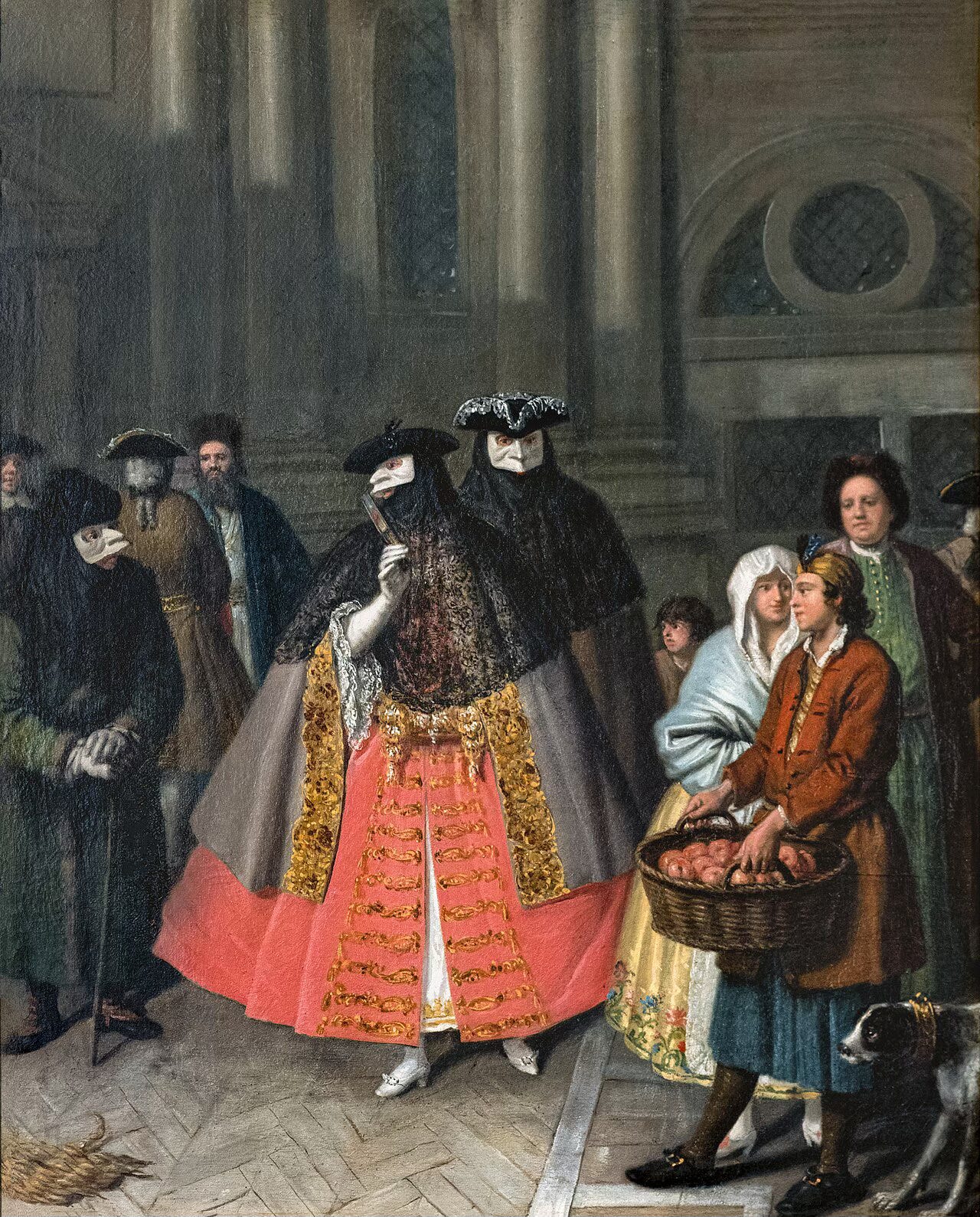
The bauta is about mobility and leverage: you stay anonymous so you can move through rooms freely, observe, negotiate, and avoid being quickly categorized. It’s an active concealment, meant to keep you flexible. This is someone who prefers mobility inside other people’s assumptions. Someone who keeps to themselves just enough to keep their private life from becoming public, and who knows that anonymity can be a powerful tool.
In modern life, the bauta shows up as the person who keeps their private life private and moves through public life without offering too many details. They listen carefully, ask good questions, and reveal very little about themselves. Online, they share very little, post rarely, and don’t leave enough personal details for people to figure them out.
When you feel most powerful, do you show more of yourself, or less?
The moretta
This was a small, oval, black velvet mask worn by women in Venice, especially in the 18th century. Unlike masks tied with ribbons, it was typically held in place from the inside by biting a small button or bit, which meant the wearer could not speak while wearing it. It covered the face with wide eye openings, often with a veil added, and it derived from the French “visard/vizard” tradition before becoming its own distinctly Venetian form.
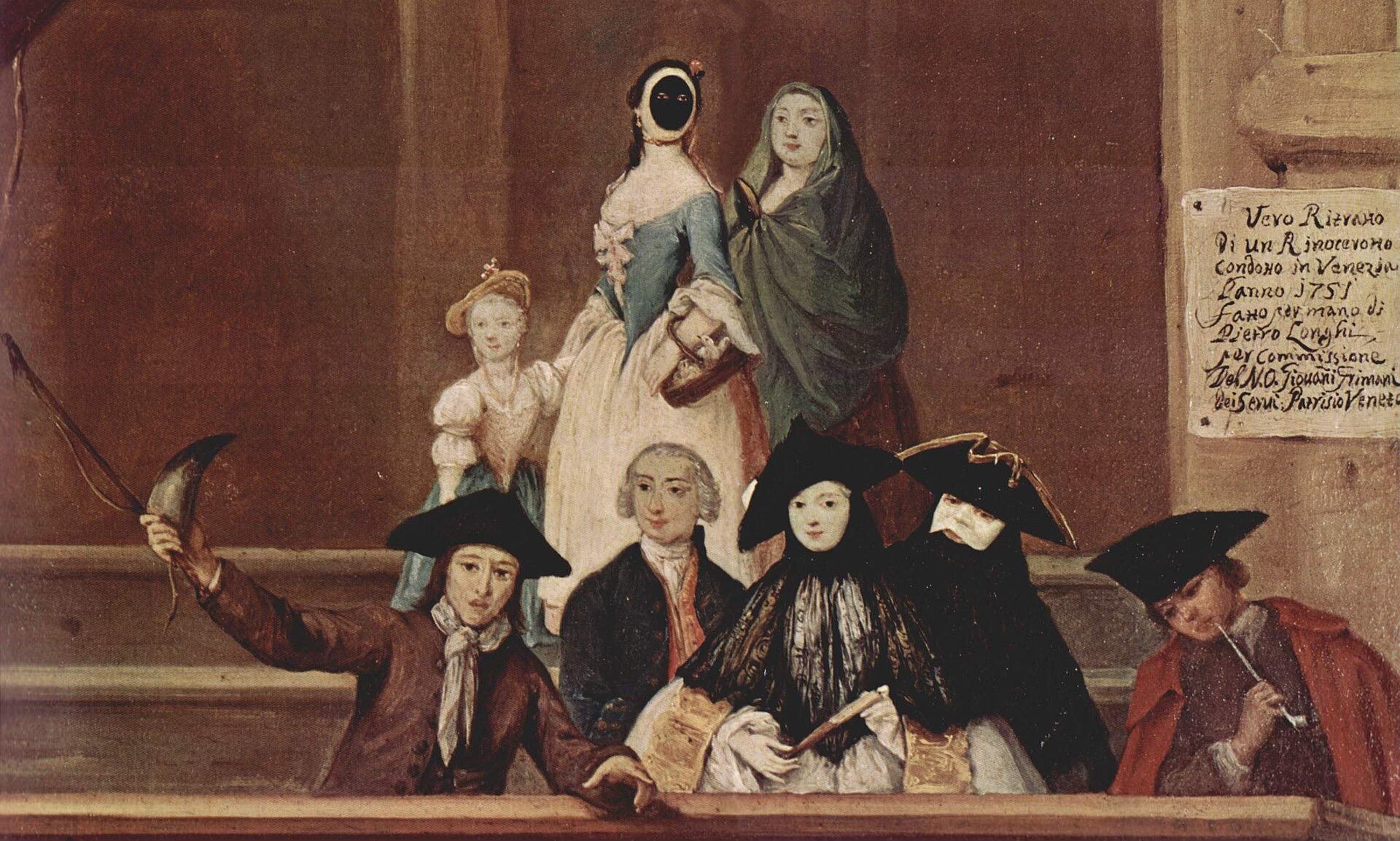
The moretta is about withholding and silence. It hides your identity but also limits your speech. The power is in refusing access to yourself, refusing explanation, and letting other people sit with what they project onto you.
You can see the moretta today in the person who does not over-explain. They answer what is necessary and then stop, leaving silence where others would rush to fill it. Online, they share little, avoid long clarifications, and let other people sit with their own assumptions.
When you stay quiet, are you listening, or avoiding being known?
Medico della Peste
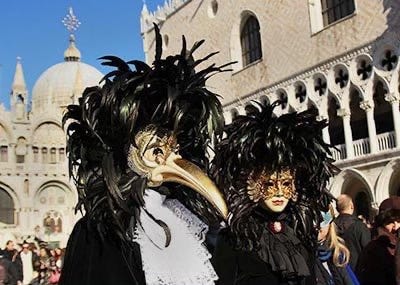
The plague doctor mask has its roots in early modern plague outbreaks, not in the medieval Black Death the way people often assume. The long beak belongs to a period when disease was widely explained through miasma, the idea of “bad air,” and the beak could be filled with aromatic substances meant to filter or protect the wearer. The full outfit was a protective costume with a hat, coat, gloves, and the beaked mask with glass eye openings. Over time, the beak moved from medical reality into cultural symbol, and eventually into Carnival as a stylized emblem of fear, illness, and death turned into theatre.
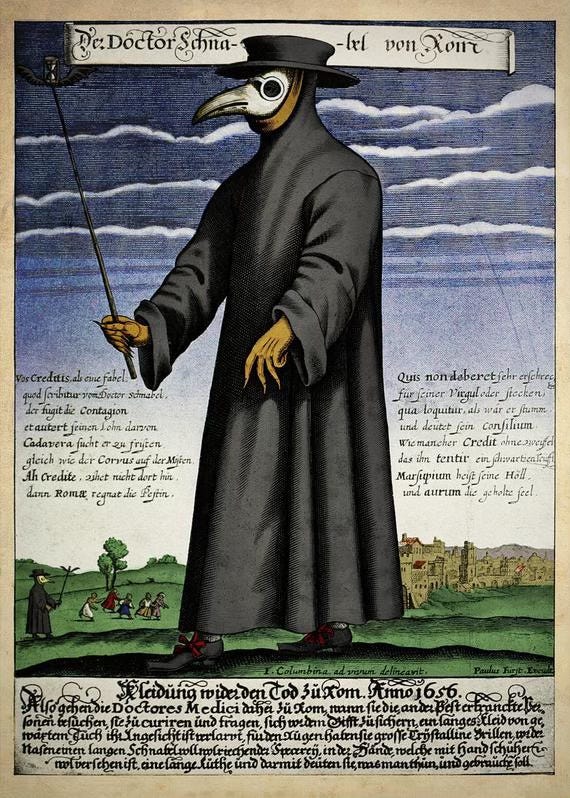
This is someone who can look at what terrifies other people without trembling, or who at least wants to appear that way. They would rather name the worst thing directly than pretend it is not there. Sometimes that is courage. Sometimes it is a way of staying in control. If you can talk about the dark calmly, you never have to admit you are afraid.
The plague doctor lives on in the person who can talk about hard subjects without getting rattled. They can name what others avoid and stay composed while everyone else shifts in their seat. Online, they respond to fear with information, not emotion. Links, facts, explanations, and sometimes dry humor to keep a safe distance.
Do you face the dark because you are brave, or because you are trying to stay in control of what scares you?
Volto (Larva)
This is the blank white face that has become the most iconic Venetian image. It covers the entire face and creates blank anonymity, often worn with a cloak and a tricorne, sometimes simple and undecorated, sometimes ornate depending on period and context. The word “larva” carries an older sense of ghostliness, and the effect is exactly that: a person becomes less individual, less readable, more like a moving absence.
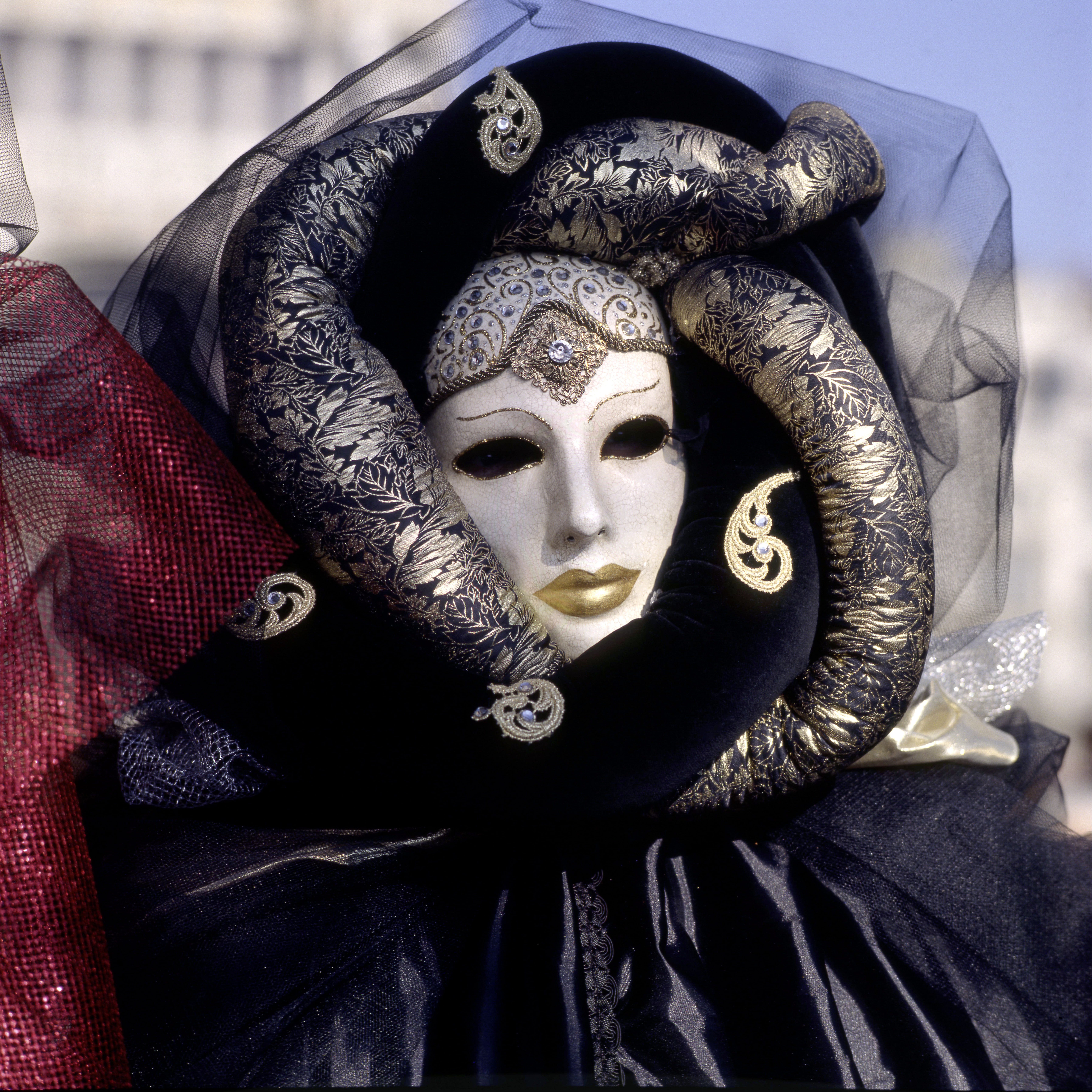
This is someone who wants relief from being “known” as a fixed story. Someone who is tired of being interpreted through their biography, reputation, and labels. Someone who wants to exist without being pinned to what they have been before.
The volto shows up now as reinvention culture, the person who wants a slate wiped clean. They keep their history vague and do not offer easy labels to hold them in place. Online, they keep things minimal and unclear. They do not want their story turned into public material.
Is this a fresh start, or are you trying to disappear from your past?
Arlecchino
This comes from commedia dell’arte rather than Venetian civic life, but Carnival absorbed him easily. Arlecchino is a comic servant character, recognized by his patched costume and dark half-mask with a mischievous, almost animal or devilish look. He’s quick, hungry, opportunistic, and hard to pin down, because he survives by turning everything into an advantage.
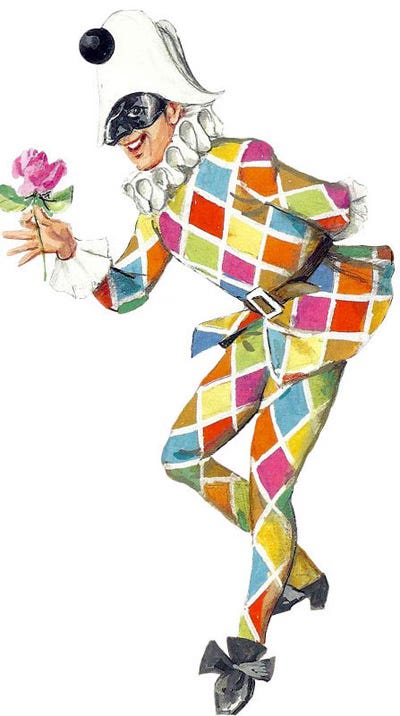
This is someone who survives by speed. Someone who can turn tension into humor, problems into improvisation, and consequences into a joke. Someone who stays hard to corner because they can always change the frame, change the mood, change the story, and make it look effortless.
Arlecchino appears in the person who keeps everyone laughing so they don’t have to be taken seriously. Humor becomes the exit door. They can cut through tension with a joke that lands perfectly, and the moment anything turns personal, they pivot back into performance. Online, they keep the tone playful so they never have to stand still long enough to be read.
Is your humor how you tell the truth, or how you dodge it?
Gnaga
This is a cat-faced mask tied to Carnival transgression in Venice, historically associated with men dressing as women, exaggerated feminine performance, and the ambiguous social shelter that masking could create. It is often described alongside behaviors like mock meowing and a deliberately vulgar, teasing presence. The gnaga belongs to the space where the city’s rules could be bent under the cover of character.
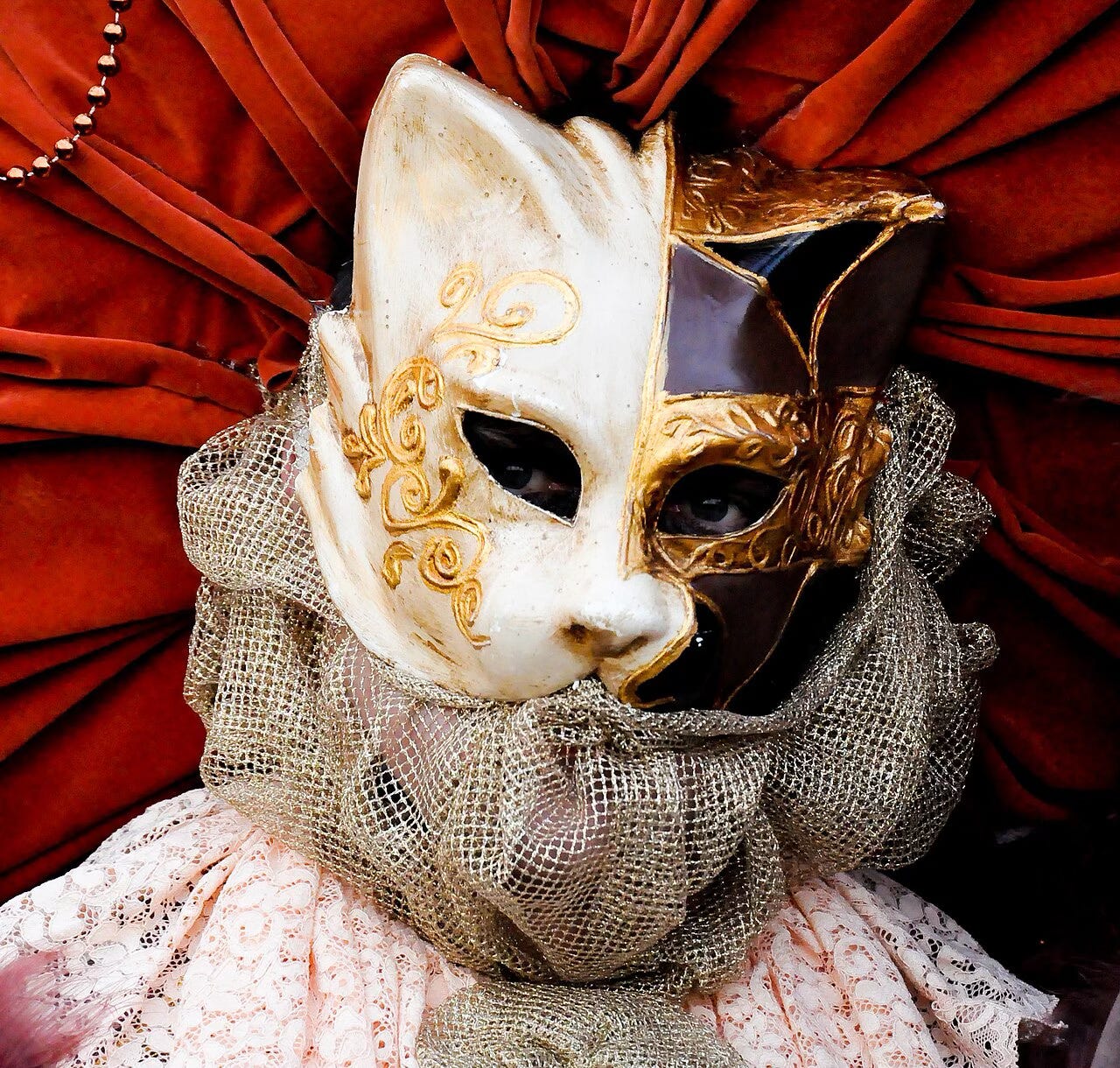
This is someone who uses performance to make the forbidden speakable. Someone who steps over a line while calling it play. Someone who tells the truth through costume because the truth cannot safely be spoken bare-faced.
The gnaga still lives in the alternate self. The person who can only admit certain desires, opinions, or hungers when they are framed as play, character, irony, or anonymity. Online, they use a private account, a pseudonym, or an alternate identity to say what would cost them too much otherwise.
Are you playing, or hiding so you can say what you really mean?
Colombina
This is the decorated half-mask most people picture when they think of masquerade glamour. It is tied to the commedia dell’arte character (the clever maidservant, the flirt, the social tactician), and in modern Venetian mask culture it is typically ornate, often with gold, jewels, lace, or feathers, covering the eyes and upper face while leaving the mouth visible.
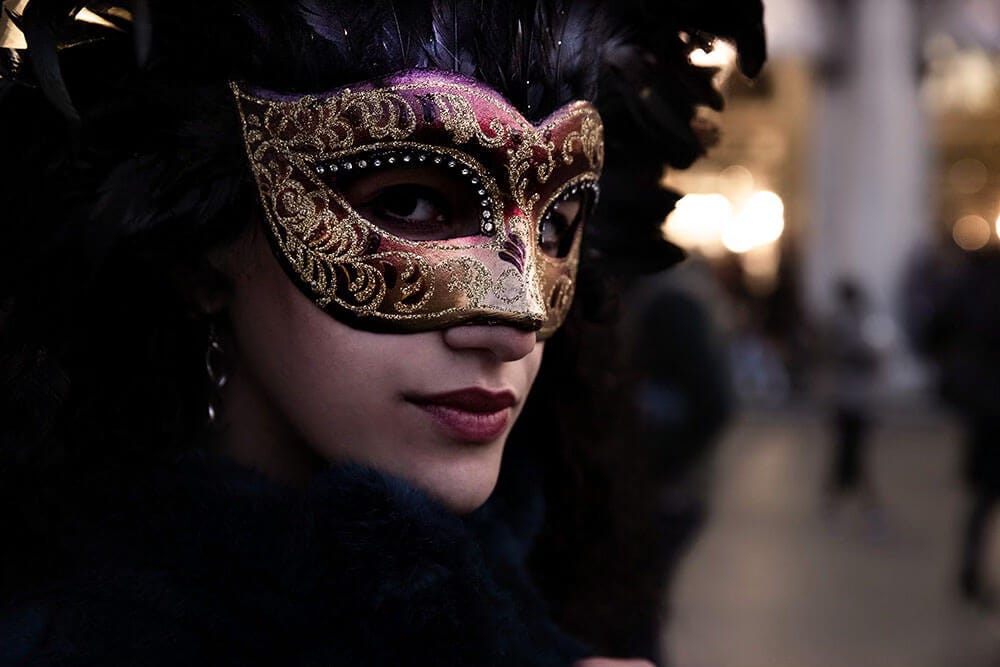
This is someone who understands selective revelation. Someone who keeps the mouth free because speech is part of the power. Someone who reveals warmth, charm, sweetness, and keeps the deeper self protected. Not deception, exactly, but the art of offering access to themselves in measured doses.
Colombina, in modern life, is the person who knows how to be charming without being exposed. They offer warmth and ease, but you still don’t get their whole inner life. Online, they can feel intimate and inviting while keeping their deeper self protected.
Do you reveal your sweetness because it is authentic, or because it is useful?
Pierrot
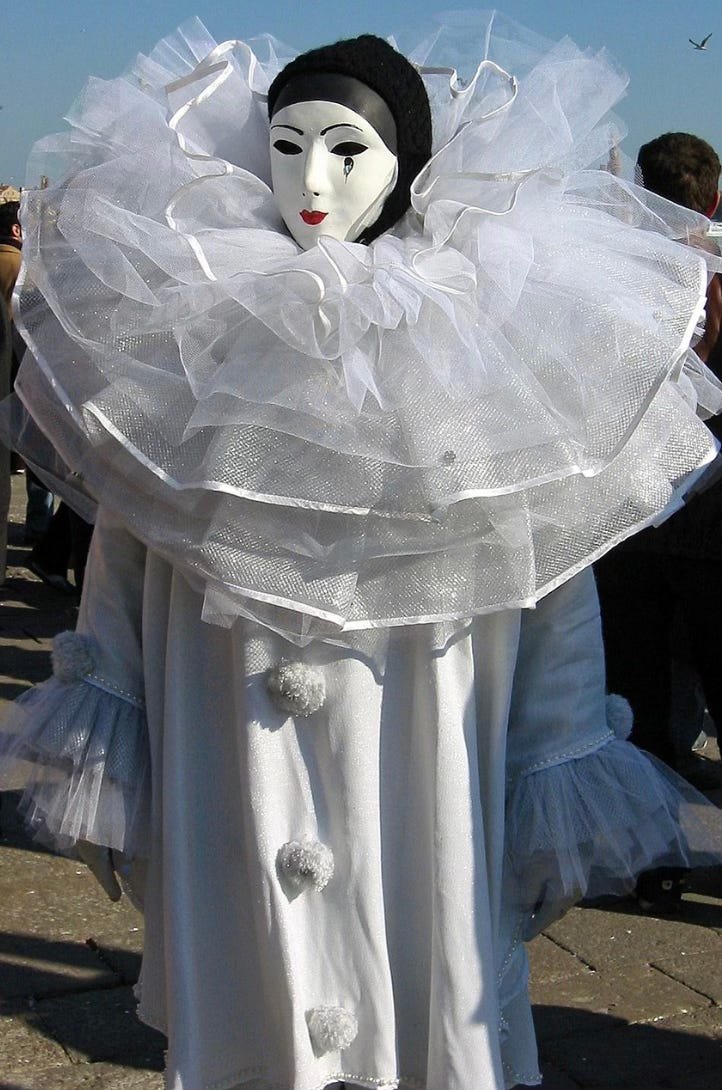
This is not a Venetian civic mask so much as an evolving theatrical archetype, emerging from the commedia tradition and becoming famous through Italian performers in Paris. He is often unmasked but white-faced, dressed in loose white clothing, and shaped into the figure we now recognize as the sad clown, tender, naïve, and exposed. Pierrot is the costume of longing, recognizable enough that people can tell what he is feeling before any word is spoken.

.png)


This is someone who turns their vulnerability and sensitivity into a role the world understands and, sometimes, rewards. Someone who can be sincere and still protected from the consequences of being personally exposed. Sincerity in this case is framed as a known character, which means it is touching, but also containable.
Pierrot shows up now as curated melancholy. The person who feels a lot and lets people see it, but in a way that remains recognizable and safe. Their tenderness becomes what others expect of them. Online, sadness and longing can be easier to share than real intimacy.
Are you showing your feelings to be close, or to stay safely at a distance?
Scaramouche
This comes from commedia dell’arte as a crafty, swaggering figure tied to intrigue and bravado, a variation on the braggart-soldier lineage. He is theatrical confidence, fast speech, clever escape, and the ability to talk his way out of what he created. Often dressed-to-kill in cape, feathered hat, high boots, with sword in belt, and marked by a showman’s energy that runs ahead of consequences.
This is someone who sounds sure of themselves right away. They talk fast, decide fast, and keep the energy moving so there’s no pause for doubt. Sometimes they truly are confident, but sometimes the speed is the point. If they slow down, fear catches up.
Scaramouche lives on in the person who stays ahead of doubt by staying in motion. They speak quickly, decide quickly, and keep the energy moving so nothing heavy can land. Online, they keep control through tone and momentum, and the crash only happens later, in private.
Do you move fast because you’re confident, or because slowing down scares you?
Lastly, I will leave you with this beautiful contemplation by Mutribo which I have shared once before. This is from the book Signposts Back Home, which is a meditation companion created in collaboration with The Broad Place:


If your persona vanished tomorrow, what would still be true about you?
Until next time,
Mihaela
PS: If this topic interests you, here are a few books I have found very interesting on masks and the social self:
Venice Incognito: Masks in the Serene Republic by James H. Johnson
A vivid, historically grounded look at how masking actually worked in early modern Venice, not as a costume detail but as a social tool that shaped anonymity, access, and everyday public life.
Paris Concealed: Masks in the City of Light by James H. Johnson
A wide-ranging history of masks both visible and invisible in Paris from the time of Louis XIV into the 19th century, showing how disguise, manners, performance, and “social faces” evolve with the city.
Two Essays on Analytical Psychology (Collected Works, Vol. 7) by Carl Jung
This contains “The Relations Between the Ego and the Unconscious,” including the section “The Persona as a Segment of the Collective Psyche,” and it’s one of the clearest places Jung explains the persona as a social “mask” and why identifying with it becomes a problem. Also Aion: Researches into the Phenomenology of the Self, which explains the shadow and the cost of refusing what we don’t want to know about ourselves. This one is a heavier read, but a great reference for shadow-work behind social performance.
*And lastly, if you ever get the chance to attend a masked ball, go. (What mask would you wear?)