
Logic 101
A small workout for your brain

I am going to let my inner math-and-science nerd out for a moment. This is part explanation, part rant, because I’ve been noticing more and more lately how casually people make claims online that sound like solid reasoning, but aren’t.
I think almost everyone would benefit from taking a logic course. Not because we all plan to become mathematicians, but because logic is practical. It helps you see what a sentence actually commits you to, and what it absolutely does not allow you to conclude. It gives you a way to pause before your brain takes a shortcut and starts treating a confident statement as a fact.
I’ll try to keep this as simple as I can, so hopefully it will make sense even if you’ve never taken logic in school.
Logic is the study of valid inference. It trains you to see the skeleton of an argument underneath the vibe of the words.
As a side note, my mind naturally works that way. I question things automatically, which can be useful, but it can also be exhausting. There have been times when I’ve wished I could just accept statements as true, pretend they made enough sense, and live in ignorance. Ignorance is bliss, they say. Unfortunately, that is easier said than done.
But I have also learned the hard way that logical analysis is not what every moment requires. So please keep that in mind as you read further. A friendly conversation, a joke, a moment of comfort, a grieving friend or parent, a nervous child, a tense marriage conversation… these don’t run on logic, and neither do your closest relationships. If someone needs a listening ear, logic can be the wrong tool. If you have children, you already know that being “right” and using logic is not the same as being helpful. And as you’ve probably experienced, as I have too, when emotions are high, logic tends to fly out the window.
So no, I am not saying we should use logic everywhere, all the time, in every circumstance.
But when you are absorbing information from media sources, including social media, logic becomes incredibly helpful. Online, we are constantly fed statements that begin as “in my experience” and somehow turn into “this is how people are.” “This is associated with that” becomes “this causes that.” “Often” somehow becomes “always.”
And when a claim you’re reading makes your brain feel like it’s short-circuiting, it’s often because the reasoning really is missing a step, or because the conclusion is stronger than the evidence allows.
A tiny vocabulary lesson (so we’re all speaking the same language)
Before we talk about how online arguments go wrong, we need a shared vocabulary for what “and,” “or,” “not,” and “if…then” actually mean.
In logic, we treat everyday sentences as propositions. These are statements that can be true or false. So let A and B stand for propositions. They can be simple (“she exercises”) or more scientific-sounding (“this study found an association between X and Y”). The goal is to make it easier to see what a claim truly says, and what it does not say.
And: A ^ B
This means both statements are true.
Example: A = “She exercises regularly.” B = “She eats a high-protein breakfast.”
A ^ B = “She exercises regularly and she eats a high-protein breakfast.”
This is only true if both parts are true.Or: A v B
This means at least one is true (it can be both).
Example: A = “She goes to the gym today.” B = “She goes for a walk today.”
A v B = “She goes to the gym today or she goes for a walk today (or both).”Not: ~A
This means A is false.
Example: A = “She exercises regularly.”
~A = “She does not exercise regularly.”
Negation doesn’t create a “different” claim. It directly contradicts A.If…then (implication): A -> B
This is the big one online, and it is constantly misused.
A simple example: A = “This shape is a square.” B = “This shape is a rectangle.”
A -> B = “If this shape is a square, then it is a rectangle.” (That holds by definition.)But online, people often treat everyday life as if it worked like that:
A = “She exercises regularly.” B = “She has lower blood pressure.”
They imply A -> B: “If she exercises, then she will have lower blood pressure.”
In real life, this is not guaranteed. Genetics, stress, sleep, medications, chronic conditions, and measurement conditions can all interfere. At best, many studies support something probabilistic like: “Exercise is associated with lower blood pressure on average in certain groups,” which is not the same as A -> B for every individual.If and only if (equivalence): A <-> B
This means A and B always have the same truth value. Each implies the other.
It’s shorthand for: (A -> B) ^ (B -> A)
Example: A = “This number is even.” B = “This number is divisible by 2.”
A <-> B works because those statements match exactly.But online, people often slip into an “if and only if” vibe about human behavior:
“Do X <-> get Y.”
Real life almost never works that way. Many different paths can lead to Y, and X might be only one factor, or even just a marker for other causes (history, personality, physiology, context). In everyday life, <-> claims are extremely strong and relatively rare. If you see someone implying it about human nature, it’s usually a red flag.
Two reasoning shortcuts I see everywhere online
1) Implication misuse (A -> B)
Remember: A -> B means “If A, then B.” It does not mean A is the only route to B, and it does not let you reverse the direction.
One common shortcut is flipping it.
Someone says: “If someone is confident (A), they speak up (B).”
Then they treat it like: “She spoke up (B), so she must be confident (A).”
But speaking up can happen for many reasons: anger, urgency, duty, practice, personality, even sheer exhaustion. B does not prove A. In logic terms, they are sneaking in B -> A, which was never given.
Another shortcut is turning it into “only if.”
“If you’re disciplined (A), you’ll be successful (B).”
Even if discipline helps, success can also involve timing, luck, opportunity, networks, background, and randomness. So it’s faulty to act as if success happens only if discipline is present.
If you want to test the validity of a statement when you see “If A, then B,” ask:
Can B happen without A? If yes, then B does not prove A.
Can A happen without B? If yes, then A is not the only route to B.
If either answer is yes, the post is probably pushing a stronger conclusion than the logic allows.
2) Biconditional misuse (A <-> B)
Remember: A <-> B is a perfect two-way link. A and B come as a package. If one is missing, the other must be missing too.
That’s common in math, but it is rare in real life. And yet it is everywhere online.
A classic example: “If he likes you (A), he’ll text back quickly (B).”
Once that sentence is accepted as true, people treat the reverse as true too: “He texted back quickly (B), so he must like you (A).” Or they treat slow replies as proof of the opposite: “He didn’t text back quickly, so he must not like you.”
But people can like you and reply slowly (work, stress, family, different habits). And people can reply quickly for reasons unrelated to liking you (availability, boredom, politeness, wanting attention). So A does not guarantee B, and B does not prove A. That means A <-> B is far too strong of a statement.
Another version is when one outward behavior gets treated as proof of an entire hidden motive.
“If he doesn’t post photos with you online (B), he’s hiding you (A).”
Then it becomes: “He’s hiding you (A), so of course he won’t post you (B).” And people treat posting as proof of good intentions: “He posts you, so he must not be hiding you.”
But not posting can mean privacy, low social media use, professional boundaries, family dynamics, cultural reasons, past drama, or simply not wanting a relationship performed for an audience. And someone can post you constantly and still be dishonest or emotionally unavailable. Posting online is not a logical guarantee of private reality. It can be a data point in a bigger conversation, but it isn’t a verdict.
If someone implies A <-> B, ask:
Can A happen without B?
Can B happen without A?
If either answer is yes, the “if and only if” doesn’t work.
A quick science add-on (because a lot of posts pretend to be “studies”)
Whenever you make a claim about people, behavior, psychology, or physiology, honest reporting requires context. At minimum, you need:
Sample size (N): How many people? Small samples can be unstable.
Who the sample is: age range, location, recruitment method, background.
What the variables actually mean: how did they measure X and Y?
Confounders: did they account for other factors that could explain the pattern?
Uncertainty: confidence intervals, and effect size (how big the difference actually is).
Error and variability: margin of error for polls, and uncertainty for estimates.
Without this, you often don’t have “science.” You have an attention-grabbing sentence.
If a study finds a pattern, the careful structure usually sounds more like:
“The probability of Y given X is greater than the probability of Y given not X.”
That is a probability statement, not an absolute implication. It leaves room for real life:
Some people do X and don’t get Y.
Some people don’t do X and still get Y.
X might not be a cause at all. It might be a symptom, or a byproduct of some third factor.
Not as sexy, but much more accurate.
The point I’m trying to make is that logic, real logic, can help you stop being manipulated by sentences that sound scientific while being structurally invalid.
I’ll give you an example of a post I recently came across that triggered this entire rant. I will blur out the account names, because I am not trying to call out anyone in particular. This just offered a perfect example of writing that sounds like an argument, but mostly runs on insinuation, stereotypes, and logical leaps.
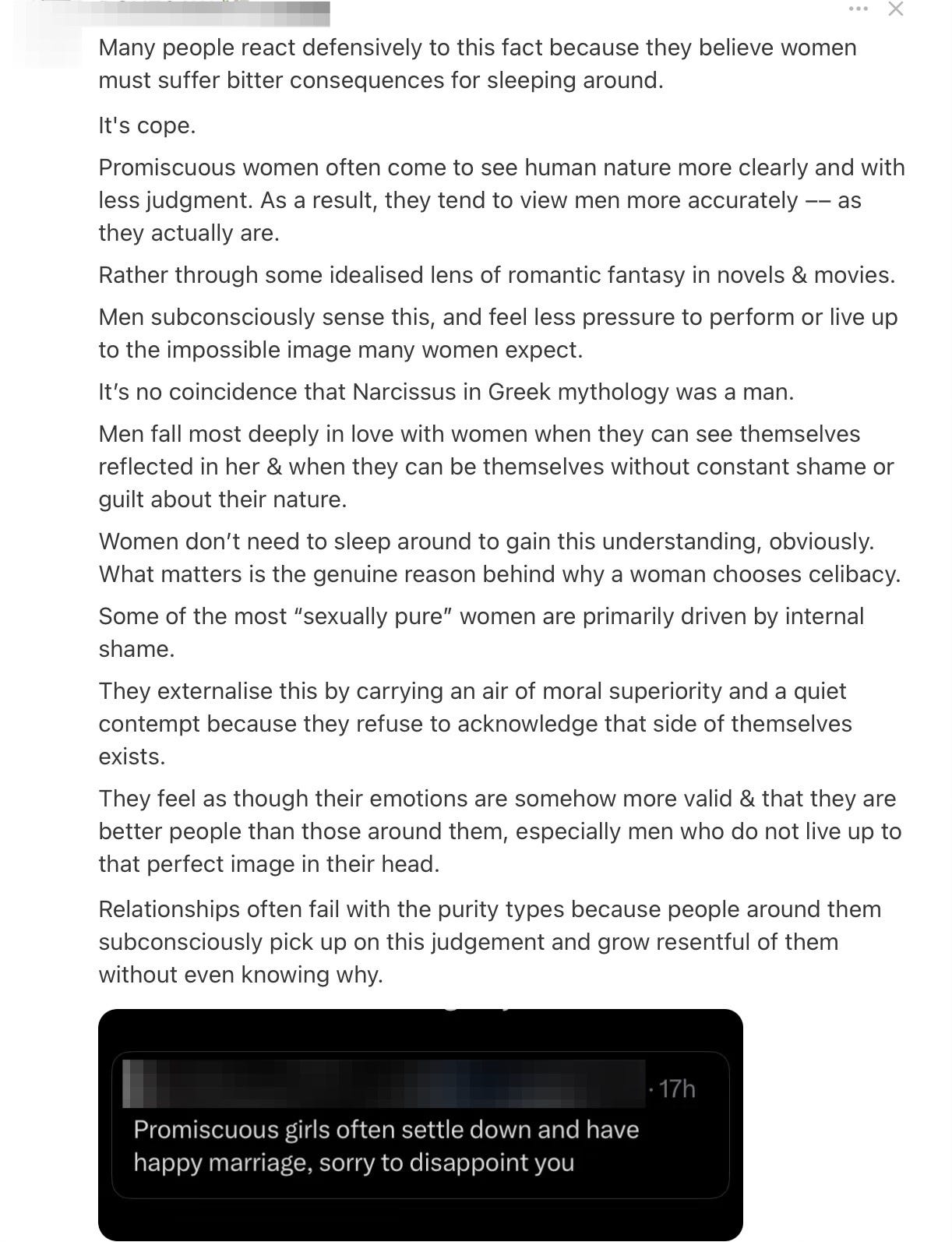
Now, the statement could have been meant as a joke, or personal experience, or an anecdote. I could be wrong and maybe I’ve misunderstood the intention. But to me it reads as a generalized claim, and that’s why I chose it. I’m not evaluating whether it’s morally “good” or “bad.” I’m evaluating whether the reasoning works.
When a post makes a sweeping claim, the first step is to name its moving parts. So, let’s break it down.
A: A woman has many sexual partners (“promiscuous”).
B: She becomes clearer-eyed about “human nature” and less judgmental.
C: She therefore sees men more accurately (less idealized).
D: Men sense this and feel less pressure to perform, so they fall more deeply in love.
The post also adds a contrasting storyline:
E: Some women choose celibacy because of shame.
F: That shame gets expressed as moral superiority or contempt.
Then it asks you to accept this chain:
A -> B
B -> C
C -> D
So the implied conclusion is: A -> D. And the contrast implies E -> F.
That is a strong claim. The question is: does the reasoning justify those arrows?
Here’s what’s missing for it to be as valid as it sounds.
First, the post leans heavily on words like “often” and “most,” but “often” is doing a lot of work with no numbers attached. Often compared to what? In which age group? In which culture? In which context? A claim can’t be “often” in the abstract. It’s always “often” in some population under some conditions.
Second, it treats correlation like causation. “As a result” is a causation phrase, but there’s no comparison group, no attempt to rule out other explanations, and no acknowledgement of complexity. Even if some pattern existed in a certain group, the honest form would usually be probabilistic: “This is more likely,” not “this leads to.”
Third, the biggest missing piece is the third-variable problem. A different factor (call it X: maturity, secure attachment, personality, values, previous relationship experience, age, learning) could make both A more likely and B/C more likely. If that’s true, then promiscuity is not “the cause.” It’s just something that sometimes comes along with the real cause. The post reads as if A produces B, when it could easily be X producing both A and B.
Fourth, several of the key links are asserted in a way that makes them hard to test. “Men subconsciously sense this” connects the story without showing how it could be checked. What would we observe if this were false? What evidence would count against it? If nothing could count against it, then it’s functioning more like a narrative device than a supported premise.
Fifth, the Narcissus reference may sound clever, but it doesn’t logically support the chain A -> B -> C -> D. Myths can illustrate themes. They don’t establish population-level psychology. At best it’s a metaphor, not a step in an argument.
Sixth, it frames celibacy as either “genuine” or shame that turns into contempt, while ignoring many other motivations: religion, health, trauma recovery, personal preference, circumstances, priorities, asexuality, privacy. Reducing a complex human choice to two motives is logically sloppy, and it makes the conclusion feel more certain than it has earned.
And finally, the post does a bit of mind-reading. When a writer explains disagreement by diagnosing motives (“cope,” “shame,” “moral superiority”), they’re assigning an inner story to strangers. That can be persuasive, but it isn’t logical support. Even if some critics have bad motives, that would not magically prove the psychological claims that follow.
None of this proves the author is “wrong” in every detail, but it does show that the post is written with the confidence of a proven argument, while it skips the steps that would be required to make the argument logically sound.
And the part where my skepticism really kicks in is where is the actual evidence?
The post is written like a report of how people behave in the world, but it offers no sources, no studies, no sample, no definitions, not even clarity on whether this is personal observation or a general claim about human nature. It’s delivered as if it were a fact, but it isn’t supported like a fact.
Anyone can make any claim they want online. The difference between an insight and an assertion is whether the writer can show you how they know. If you’re going to make broad psychological claims about “men,” “women,” “promiscuity,” “celibacy,” and what causes love or resentment, you owe the reader more than just your confidence. What and whose evidence are you relying on?
I believe in freedom of speech. But I also believe that speech has weight, especially when it is amplified. If you have a large following, you are not just expressing an opinion, you are shaping the inference habits of thousands of minds at once. And while nobody is morally obligated to be perfect, there is a basic duty that comes with influence: to make claims as accurate as you can, to state your certainty level honestly, and to offer context and references when you are presenting something as “how people are.” At minimum, if your words are likely to hurt, polarize, or trigger, you should make sure the argument you’re making is logically coherent, and that you are not pulling a sweeping conclusion out of a thin premise.
For the reader, the hard truth is that you cannot curate reality. You will never be able to control what other people post, and you cannot regulate the internet into sanity. So your power is not in policing every claim, but in protecting your own mind.
When something online triggers you, use it as a signal to pause and ask better questions. First: what exactly is being claimed? Is it an observation, a hypothesis, a moral judgment, a stereotype, a causal claim disguised as “common sense”? Second: is there evidence here, or only confidence? Third: what else could explain it? Fourth: what would make this claim false?
And yes, sometimes what stings is true, or true enough to be useful. In those cases, the discomfort can be information. It can point to a boundary you need to set, a pattern you need to admit, a standard you need to raise, a conversation you need to have, a change you’ve been postponing.
But sometimes what triggers you is not truth. It is bad reasoning, or a cheap generalization. It is someone else’s unresolved contempt dressed up as insight, or a sentence engineered to provoke rather than illuminate. In those cases, the most self-respecting response is not engagement, not rebuttal, not outrage, but not engaging. Not every claim or provocation deserves your attention.
Critical thinking, in the end, is a form of inner sovereignty, the ability to keep your mind from being hijacked by other people’s certainty. In a culture that rewards hot takes and avoids nuance, you can still choose to think carefully. That is not just intelligence. I am going to call that dignity.
If you’ve read all the way to the end and you’re still with me, thank you for putting up with my nerdy side (and my little rant). I hope it made sense.
Wishing you a beautiful day.
Until next time,
Mihaela
PS: Joe Folley has made a few YouTube shorts on logic, as well as some longer videos discussing logic. Here is a fun one:
“Critical thinking is a form of inner sovereignty.” That line alone justifies the whole essay. What I find most valuable here is not the logic primer itself it’s the framing around when logic applies and when it doesn’t. Most people who write about reasoning forget to say that. The best part of this piece is the first three paragraphs.